4051238391_636a4c5ce1_z

Last week, we began addressing the issue of the average lag time from grant of review to oral argument and from argument to decision, analyzing the data for the civil and criminal dockets from 2000 to 2007.  This week, we’ll address the data for 2008 through 2016, beginning today with the civil docket.

There is substantial evidence that the average time from grant of review to oral argument is continuing to drift upwards.  As we saw last week, for most of the first half of our study period, the average lag was between 500 and 600 days, only moving north of that figure in 2007.  In 2008, the average lag from grant to argument was 672.8 days.  The number dropped over the next three years, to 558.09 in 2009, 560.9 in 2010 and only 461.33 in 2011.  The average was up significantly in 2012 to 631.08 days.  It fell to 558.63 days in 2013, but has risen every year since: to 610.04 in 2014, 627.56 in 2015 and to a new high of 680.03 in 2016.
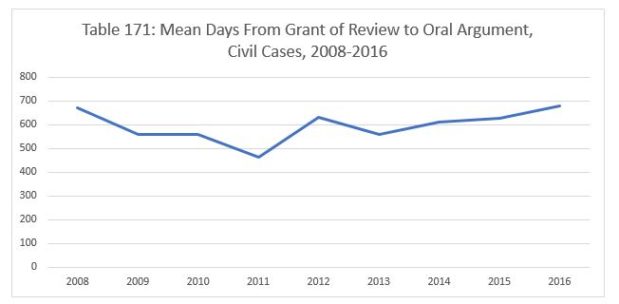
Table 171

In Table 172, we report the mean days from oral argument to decision for the same period.  For 2008, the average time was 71.53 days.  That number fell for the three years following – to 68.25 in 2009, 65.31 in 2010 and 61.33 in 2011.  The mean rose to 69.5 in 2012, and was flat the following year at 69.69.  But like the lag from grant of review to argument, it has increased every year since – to 70.48 in 2014, 72.13 in 2015 and 78.97 in 2016.
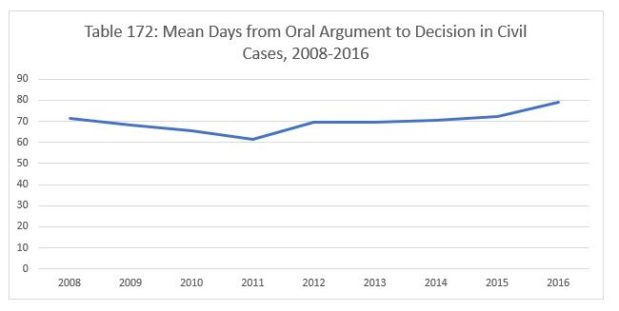
Table 172

Join us back here tomorrow as we look at trends in lag times for the Court’s criminal docket during the same period.

Image courtesy of Flickr by Ken Lund (no changes).

14162069538_aba7d2f8c1_z

Yesterday, we analyzed the average lag time from grant of review to oral argument, and oral argument to decision, in civil cases between 2000 and 2007.  Today, we turn our attention to the Court’s criminal docket for the same years.

For the entire period, the average lag time from grant of review to oral argument in criminal cases was roughly double the lag time in civil cases.  For 2000, the average criminal case lasted 1,114.38 days from grant to argument.  The next year, the average dropped to 1,015.897.  For 2002, the average dropped further to 908.871.  The average increased substantially for the rest of the period.  In 2003, the average was 1,260.194.  The next year, it was slightly higher – 1,288.836.  For 2005, the average was 1,689.574.  The next year, the average was down slightly at 1,583.491.  For 2007, the average was 1,458.836.

Table 169

For 2000, the average lag time from oral argument to decision in criminal cases was 8 days.  For 2001, the average was down a bit to 65.914 days.  For 2002, the average was up to 71.029 days, and the next year, it was 73.419 days.  For 2004, the average was 74.082 days.  The average dropped for 2005 to 72.738 days, but it increased to 75.245 days in 2006.  For 2007, the average lag time from oral argument to decision to its lowest level since 2001 at 69.967 days.

Table 170

Join us back here next Thursday as we analyze the Court’s average lag times in civil cases from 2008 to 2016.

Image courtesy of Flickr by Harold Litwiler (no changes).

3988362967_158ed3bd1a_z

This week, we begin a new phase of our analysis: how long does the average case remain pending at the California Supreme Court from grant of review to oral argument to decision, and what are the differences between civil, criminal and death penalty cases?

In Table 167 below, we report the mean number of days, year by year, from grant of review to oral argument in civil cases.  In 2000, the Court averaged 559.959 days per case from grant to argument.  The following year, the average had dropped to 510.313.  For 2002 and 2003, the average remained flat – 511.75 in 2002, and 511.455 in 2003.  But for 2004, the average lag time from grant to argument rose about 10% to 568.434 days.  For 2005, the average rose even further to 602.451.  The days from grant to argument was relatively flat in 2006 at 599 days, before rising to 637.714 days in 2007.

Table 167

In Table 168, we report the mean number of days from oral argument to decision for the same years.  In 2000, the average civil decision took 76.347 days from argument to decision.  That figure dropped to 70.25 days for 2001 before rising to 75.458 days in 2002 and 74.045 days in 2003.  In the years since, the average has dropped slightly, to 71.981 days in 2004, 69.9804 days in 2005, 68.396 days in 2006 and 69.875 days in 2007.

Table 168

Join us back here tomorrow as we turn our attention to the Court’s criminal docket between 2000 and 2007.

Image courtesy of Flickr by Robert Bejil (no changes).

13408590515_88a6cdb87d

This week, we’ve been taking a look at the voting patterns of pro tem Justices on the California Supreme Court since 2000. Yesterday, we showed that pro tem Justices have tended in civil cases to vote most similarly to what most would call the liberal wing of the Court –Justices Moreno and Liu. Justice Werdegar was third and Chief Justices George and Cantil-Sakauye were fourth and fifth, respectively. The two Justices whose voting records were most dissimilar to pro tems in civil cases were Justices Brown and Mosk. Today, we turn our attention to the Court’s criminal cases over the same period.

Once again, we begin by putting aside the Justices who voted in only a few cases where pro tems were sitting: Justices Kruger, Cuellar and Mosk. We see in Table 166 below that the voting patterns in criminal cases are to some degree exactly the reverse as the patterns in civil cases. Justice Brown, one of the lowest agreement rates in civil cases, was tied with Chief Justice George for the highest agreement rate at 92.86%. Pro tems agreed with Justice Baxter 92.38% of the time in criminal cases, and with Justice Moreno in 90.38%. They agreed with Justice Chin in 87.12% of criminal cases, with Justice Corrigan in 87% and with Justice Werdegar in 85.16%. The three lowest agreement rates for criminal cases were Justice Kennard (84.27%), Chief Justice Cantil-Sakauye (83.56%) and Justice Liu, who had one of the two highest agreement rates on the civil side, but agreed with pro tems in only 74.47% of criminal cases.


Table 166A

Join us back here next Thursday as we turn our attention to a new issue in our continuing analysis of the California Supreme Court’s decision making.

Image courtesy of Flickr by Ken Lund (no changes).

11951339355_c4331524d0

Last week, we analyzed whether the California Supreme Court’s pro tem Justices have been more or less likely to vote with the majority than permanent members of the Court since 2000. This week, we’re looking at a related issue. What impact does the presence of a pro tem Justice on the Court for a particular case have for the ideological spread of the Court? Over time, is a pro tem a net gain for the plaintiffs or the defendants? Pro tem Justices have at times been a source of controversy for the Court with some analysts concluding that pro tems tend to vote disproportionately with the Chief Justice.

First, a few ground rules for our calculations. On several occasions since 2000, retiring Justices have voted in cases which began before their retirement became effective, rather than requiring the Court to start from scratch with a newly appointed Justice. We count votes cast after the Justice has retired as votes by a pro tem Justice. Also, we count vote by vote, not case by case. For example, if a case includes two pro tem Justices, and a particular Justice and the two pro tems all vote the same way, that counts as two agreeing votes for purposes of agreement rates.

Not surprisingly, the Justices who have cast the most votes on courts involving at least one pro tem vote since 2000 are, in order, Justices Werdegar, Chin, Kennard and Baxter. If we leave aside Justices Cuellar and Kruger, both of whom cast two votes in civil cases on courts with pro tem Justices in 2016, pro tems were closest in their voting patterns in civil cases to Justice Moreno (95.4% agreement) and Justice Liu (94.59%). Third was Justice Werdegar, with an agreement rate of 92.25%. Former Chief Justice George was fourth at 91.46%. Chief Justice Cantil-Sakauye was next, agreeing with pro tems in 88.68% of civil cases, followed by Justices Kennard and Corrigan (87.6% and 87.18%, respectively) and Justices Chin and Baxter (86.18% and 86.09%). The two Justices least likely to agree with pro tem Justices in civil cases were Justice Brown (79.07% agreement) and Justice Mosk (70% agreement).


Table 165A

Join us back here tomorrow as we investigate the agreement rate between pro tem Justices and the other members of the Court in criminal cases since 2000.

Image courtesy of Flickr by Kim Schuster (no changes).

5557598849_3909453908_z

Last week, we reviewed the frequency with which pro tem Supreme Court Justices voted with the Court’s majority in criminal cases between 2000 and 2007.  Today, we review the same data between 2008 and 2016.

Seventy-eight pro tem votes were filed between 2008 and 2016.  For the period, 92.31% of the votes among pro tem Justices were cast with the majority.  But permanent members of the Court were substantially ahead, averaging 95% of the votes with the majority among permanent Justices.  One pro tem Justice joined a dissent in 2010.  One wrote a dissent in 2011.  In 2014, one pro tem Justice joined a concurrence, one wrote a dissent and three joined in dissents.

For 2008 and 2009, one hundred percent of the pro tem Justices voted with the majority, to 96.75% in 2008 and 96.78% in 2009.  In 2010, none of the Court’s pro tem Justices voted with the majority, but 94.52% of the permanent Justices did.  For 2011, 97.5% of the Court’s pro tem Justices voted with the majority.  Slightly fewer – 93.28% – of the Court’s permanent Justices voted with the majority.  In 2012, all of the pro tem Justices voted with the majority, and 94.25% of the permanent Justices did.  In 2013 and 2014, there were no pro tem votes in criminal cases.  Ninety-six percent of permanent Justices voted with the majority, and 95.06% of permanent Justices did in 2014.  For 2015, 85.71% of pro tem Justices voted with the majority.  Among permanent Justices, 93.83% did so.  Finally, no pro tem Justices voted on the criminal side in 2016, but 98.08% of permanent Justices did.

Table 164


Join us back here next Thursday as we turn our attention to a new question in our ongoing examination of the Court’s decision making.

Image courtesy of Flickr by Andrew E. Larsen (no changes).

3576309055_0eb1822d09_z

Last week, we analyzed how the voting patterns of the Court’s pro tem Justices differed from the permanent members of the Court in civil cases.  This week, we’ll be looking at the voting patterns in criminal cases between 2000 and 2015.

Between 2000 and 2007, forty votes were cast by pro tem Justices in criminal cases.  There were five pro tem votes in 2001.  Seven votes were cast in 2002.  Two were cast in 2003.  One pro tem vote was cast in 2004.  In 2005, there were eight pro tem votes.  In 2006 there were fifteen pro tem votes, and in 2007, there were two.

No pro tem Justices either wrote or joined concurrences in criminal cases between 2000 and 2007.  In 2005, two Justices joined dissents.  The following year, one pro tem Justice joined a dissent.

For most of the period, pro tem Justices were more likely to vote with the majority than permanent Justices were.  In 2001, pro tems voted with the majority in all their cases, while 95% of permanent Justices did.  In 2002, 85.71% of pro tem Justices voted with the majority to 90.41% for permanent Justices.  In 2003 and 2004, pro tems were more likely to be in the majority.  Both years, all of the pro tem votes were with the majority.  Among permanent Justices, 92.63% voted with the majority in 2003, and 94.64% of permanent Justices voted with the majority in 2004.  In 2005, three-quarters of pro tem Justices voted with the majority to 91.18% of permanent Justices.  For the final two years of the period, pro tems were once again more likely to be in the majority.  In 2006, 93.33% of pro tems were with the majority to 88.41% of permanent Justices.  In 2007, all of the pro tem votes were with the majority, while 97.42% of permanent votes were.

Table 163

Join us back here tomorrow as we turn our attention to the criminal docket between 2008 and 2016.

Image courtesy of Flickr by Rennett Stowe (no changes).

4051980600_8c7e4257ff

Yesterday, we began our investigation of a new question: how do the voting patterns of the Court’s pro tem Justices – Court of Appeal Justices assigned by the Chief Justice for one case to replace a recused or retired Justice – differ from those of the permanent members of the Court? We began our analysis by considering the Court’s civil cases between 2000 and 2007. Today, we turn our attention to the years 2008 through 2016.

During the past nine years, eighty-eight votes have been cast in civil cases by pro tem Justices. Half of the pro tem appointments were associated with retiring Justices who were not quickly replaced by the Governor: there were 23 pro tem votes cast in civil cases in 2011, 14 in 2014 and 11 in 2015. In addition, ten pro tem votes were cast in 2009, and fourteen were cast in 2010. No pro tem Justices wrote concurring opinions in civil cases during these years, but one pro tem joined a concurrence both in 2010 and 2011. Two Justices wrote dissents in 2011 and one in 2014. One pro tem Justice joined a dissent in 2013, and two did in 2014.

Dissent has been quite rare among pro tem Justices in civil cases since 2008. No pro tem sided with the minority in a civil case in 2008, 2009, 2010, 2012, 2015 or 2016. For 2011, 91.3% of the pro tem votes were with the majority. The agreement rate only dropped below the 90% rate for two years: in 2013, when it was 88.89%, and in 2014, when 71.43% of the pro tem votes were with the majority. For the entire period, 81 of 88 pro tem votes were cast with the majority – 92%. During these same years, 94.1% of votes cast by permanent Justices in civil cases were with the majority. So while permanent Justices were more likely to dissent in civil cases for the years 2000 through 2007, over the past nine years, pro tem Justices have been slightly more likely to dissent.

Table 162

Join us back here next Thursday as we turn our attention to voting patterns among pro tem Justices in the Court’s criminal cases.

Image courtesy of Flickr by Ken Lund (no changes).

16233257062_f299b6698a

One of the principal distinctions between my two principal subjects of study – the Illinois and California Supreme Courts – is that Illinois has no system for replacing Justices when the Court is short by one or more members, either because of recusal or due to the retirement of a Justice who has not yet been replaced. When one or more Justices cannot participate in Illinois, a reduced Court proceeds to decide the case. But in California, Article VI, Section 6(e) of the Constitution provides that when the Supreme Court is short one or more Justices, the Chief Justice assigns a Justice from the Court of Appeal to sit as a Supreme Court Justice Pro Tem.

This opens up interesting issues for our ongoing study of judicial behavior. Many scholars have argued that it’s the fact that appellate Justices serve together for an extended period which causes “dissent aversion” – Justices declining to vote against a result they don’t, in fact, approve of. So we might expect pro tem Justices to be more likely to dissent from the Court’s decisions than permanent Justices are.

In Table 161 below, we report the likelihood that pro tem Justices will vote with the majority, year by year, between 2000 and 2008. Six pro tem Justices participated in civil cases in 2000. Eight sat in 2001, four in 2002, eight in 2003, seven in 2004, nine in 2005, ten in 2006 and four in 2007. For 2000, 85.71% of the pro tem votes were with the majority. For 2001, eighty per cent of the votes were majority. For 2002, all votes were with the majority. In 2003, 90% of the pro tem voted were majority. That figure fell to 75% in 2004, but increased to 91.67% in 2005 and 100% in 2006 and 2007. In 2002, one pro tem wrote a concurring opinion. Pro tem Justices wrote dissents in 2001 and 2003. Other pro tem Justices joined dissents written by other Justices in 2000 and 2004.

For the entire period, ninety percent of the pro tem votes were cast for the majority – sixty-three for the majority, seven for the minority. The percentage of votes for the majority was less among permanent Justices, but only slightly less. For civil cases during the years 2000 through 2007, permanent Justices cast 2,423 votes for the majority and 286 for the minority – a percentage of 89.44% majority votes. So far from being more likely to disagree with their colleagues, at least for the first eight years of our period, pro tem Justices were less likely to dissent.

Table 161

Join us back here tomorrow as we turn our attention to the Court’s civil cases between 2008 and 2016.

Image courtesy of Flickr by Charlie Day (no changes).

14982426134_0dce580207_z

For the past few weeks, we’ve been taking a close look at the California Supreme Court’s automatic death penalty appeals docket.  Yesterday, we calculated the average time from appointment of counsel to the scheduled oral argument and looked at whether the total time under submission told us anything about what the ultimate result would be.  Today, we turn to a related subject: how long does the average death penalty appeal remain pending after oral argument?

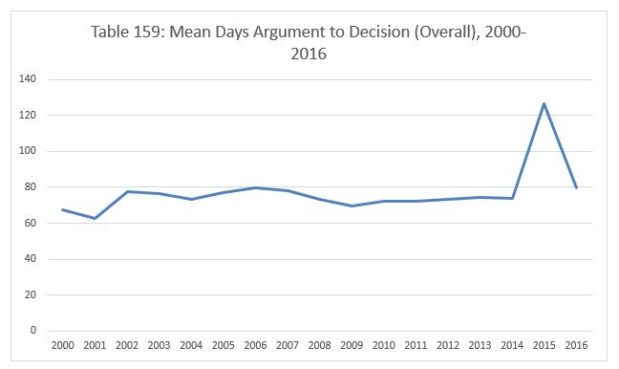
In Table 159 below, we report the mean time in days from oral argument to decision in death penalty appeals between 2000 and 2016.  With the exception of 2015, the yearly average has been quite stable, between 60 and 80 days each year.  In 2000, the average was 67.6 days.  In 2001, the average dropped to 62.91 days.  The average stayed in the 70s from 2002 through 2008 (77.43, 76.45, 73.1, 77.15, 79.53, 78.26 and 73.12 days).  In 2009, the Court averaged 69.8 days pending.  The average was between 70 and 75 days for the next five years.  In 2010, the number was 72.13 days.  In 2011, it was 72.38.  In 2012, it was 73.32.  In 2013, it was 74.61, and in 2014, the average was 73.91 days.  In 2014, we saw a one year jump to 126.35 days.  Finally, in 2016, the Court’s average was 79.67 days.

Table 159

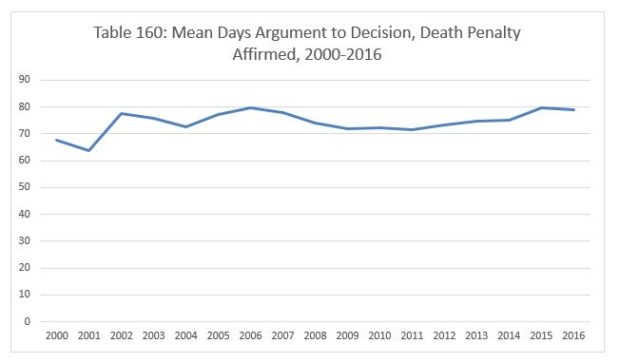
The average time under submission for the entire period in cases where the Court reversed the death penalty was 100 days.  Cases in which the penalty was affirmed were typically about one third quicker.  In 2000 and 2001, the average was below 70 days – 67.6 and 63.7 days.  The Court’s average lag time remained in the 70s for each of the fourteen years that followed.  In 2002, the average was 77.38 days.  In 2003, it was 75.88.  In 2004, it was 72.47.  In 2005, it was 77.15.  In 2006, the average was 79.53 days.  In 2007, the average was 77.91.  In 2008, the average was 74.04.  In 2009, the average was 71.7 days.  In 2010, the average was 72.13 days.  In 2011, the average was 71.68 days.  In 2012, the average was 73.38 days.  In 2013, the average was 74.61 days.  In 2014, the average was 74.95 days.  In 2015, the average increased slightly to 79.64 days.  Last year, the average was 79.11 days.

Table 160

Join us back here next Thursday as we address another issue in our ongoing analysis.

Image courtesy of Flickr by Eric May (no changes).